Qfwfq & The First Sign in the Void
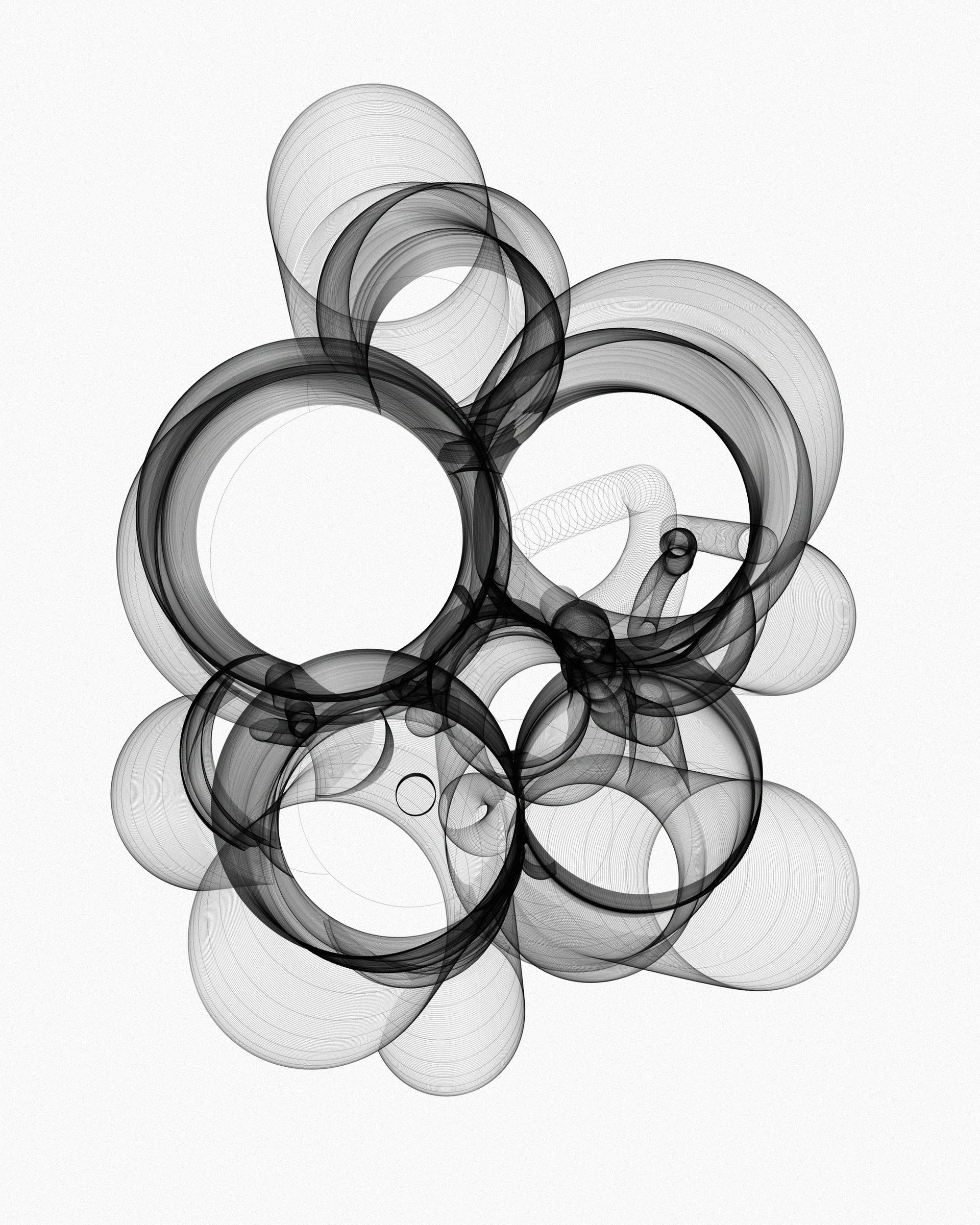
“I drew a sign at a point in space, just so I could find it again two hundred million years later.” A single intentional mark gives the entire universe a center, a coordinate, and human meaning.
You are Qfwfq in an empty universe before form or language existed. Make the very first mark in space.
One morning in Graphic Design class at the Scuola Internazionale di Grafica in Venice, professor Paola Ricci—the professor who almost kicked Pietro out of school (and she was completely right at the time)—walked into the studio and asked what happens the instant a designer draws a single mark on an empty sheet. Instead of opening a manual on layout or grids, she told a story by Italo Calvino called “Un segno nello spazio” (“A Sign in Space”, from Le Cosmicomiche, 1965).
In the story, the ancient cosmic narrator Qfwfq remembers when the universe was completely empty, uniform, and featureless. Every point in the void looked identical to every other point, and it took two hundred million years for the galaxy to complete a single rotation. Passing a random point in space, Qfwfq decides to draw the very first sign so he can recognize that exact spot when he comes back around two hundred million years later.
When Qfwfq finally returns two hundred million years later, he discovers that a jealous rival named Kgwgk has erased his mark and begun scattering counterfeit signs across the cosmos. Soon, the entire universe is flooded with trillions of effortless, imitative signs until space itself becomes a cluttered soup of visual noise—and Qfwfq is left searching for the quiet necessity of that first, honest mark.
Sixty years after Calvino wrote Qfwfq, artificial intelligence can flood the screen with a million signs in a second. Which is why returning to one intentional, human point of view—#beautifullysimple—has never mattered more.
“I drew a sign at a point in space, just so I could find it again two hundred million years later.” A single intentional mark gives the entire universe a center, a coordinate, and human meaning.
When making signs becomes automatic and unanchored from meaning, space fills with trillions of counterfeit imitations until the world is choked with noise—Calvino’s 1965 prophecy of generative surface slop.
In the post-AI era, the bottleneck is no longer generating a million signs. It is having the taste, structural honesty, and courage to strip away the noise until only the essential mark remains.
“Once again, design is not how it looks. Design is how it works.”
“Situated in the external zone of the Milky Way, the Sun takes about two hundred million years to make a complete revolution of the Galaxy. Okay, that’s how long it takes; not a day less. Once, as I went past, I drew a sign at a point in space, just so I could find it again two hundred million years later, when we went by the next time.”
— Italo Calvino, “Un segno nello spazio” (“A Sign in Space”), from Le Cosmicomiche (1965)
Qfwfq & The First Sign in the Void: “I drew a sign at a point in space, just so I could find it again two hundred million years later.” A single intentional mark gives the entire universe a center, a coordinate, and human meaning.
Kgwgk & The Flood of Counterfeits: When making signs becomes automatic and unanchored from meaning, space fills with trillions of counterfeit imitations until the world is choked with noise—Calvino’s 1965 prophecy of generative surface slop.
Omitting the Unimportant: In the post-AI era, the bottleneck is no longer generating a million signs. It is having the taste, structural honesty, and courage to strip away the noise until only the essential mark remains.
One morning in Graphic Design class at the Scuola Internazionale di Grafica in Venice, professor Paola Ricci[01]—the professor who almost kicked Pietro out of school (and she was completely right at the time)—walked into the studio and asked what happens the instant a designer draws a single mark on an empty sheet. Instead of opening a manual on layout or grids, she told a story by Italo Calvino[02] called “Un segno nello spazio” (“A Sign in Space”, from Le Cosmicomiche, 1965).
In the story, the ancient cosmic narrator Qfwfq remembers when the universe was completely empty, uniform, and featureless. Every point in the void looked identical to every other point, and it took two hundred million years for the galaxy to complete a single rotation. Passing a random point in space, Qfwfq decides to draw the very first sign so he can recognize that exact spot when he comes back around two hundred million years later.
When Qfwfq finally returns two hundred million years later, he discovers that a jealous rival named Kgwgk[01] has erased his mark and begun scattering counterfeit signs across the cosmos. Soon, the entire universe is flooded with trillions of effortless, imitative signs until space itself becomes a cluttered soup of visual noise—and Qfwfq is left searching for the quiet necessity of that first, honest mark.
Sixty years after Calvino wrote Qfwfq, artificial intelligence can flood the screen with a million signs in a second. Which is why returning to one intentional, human point of view—#beautifullysimple—has never mattered more.
You are Qfwfq in an empty universe before form or language existed. Make the very first mark in space.
Draw the first sign.
“Situated in the external zone of the Milky Way, the Sun takes about two hundred million years to make a complete revolution of the Galaxy. Okay, that’s how long it takes; not a day less. Once, as I went past, I drew a sign at a point in space, just so I could find it again two hundred million years later, when we went by the next time.”
— Italo Calvino, “Un segno nello spazio” (“A Sign in Space”), from Le Cosmicomiche (1965)
One morning in Graphic Design class at the Scuola Internazionale di Grafica in Venice, professor Paola Ricci—the professor who almost kicked Pietro out of school (and she was completely right at the time)—walked into the studio and asked what happens the instant a designer draws a single mark on an empty sheet. Instead of opening a manual on layout or grids, she told a story by Italo Calvino called “Un segno nello spazio” (“A Sign in Space”, from Le Cosmicomiche, 1965).
In the story, the ancient cosmic narrator Qfwfq remembers when the universe was completely empty, uniform, and featureless. Every point in the void looked identical to every other point, and it took two hundred million years for the galaxy to complete a single rotation. Passing a random point in space, Qfwfq decides to draw the very first sign so he can recognize that exact spot when he comes back around two hundred million years later.
When Qfwfq finally returns two hundred million years later, he discovers that a jealous rival named Kgwgk has erased his mark and begun scattering counterfeit signs across the cosmos. Soon, the entire universe is flooded with trillions of effortless, imitative signs until space itself becomes a cluttered soup of visual noise—and Qfwfq is left searching for the quiet necessity of that first, honest mark.
Sixty years after Calvino wrote Qfwfq, artificial intelligence can flood the screen with a million signs in a second. Which is why returning to one intentional, human point of view—#beautifullysimple—has never mattered more.
“I drew a sign at a point in space, just so I could find it again two hundred million years later.” A single intentional mark gives the entire universe a center, a coordinate, and human meaning.
When making signs becomes automatic and unanchored from meaning, space fills with trillions of counterfeit imitations until the world is choked with noise—Calvino’s 1965 prophecy of generative surface slop.
In the post-AI era, the bottleneck is no longer generating a million signs. It is having the taste, structural honesty, and courage to strip away the noise until only the essential mark remains.
You are Qfwfq in an empty universe before form or language existed. Make the very first mark in space.
“Situated in the external zone of the Milky Way, the Sun takes about two hundred million years to make a complete revolution of the Galaxy. Okay, that’s how long it takes; not a day less. Once, as I went past, I drew a sign at a point in space, just so I could find it again two hundred million years later, when we went by the next time.”
— Italo Calvino, “Un segno nello spazio” (“A Sign in Space”), from Le Cosmicomiche (1965)
One morning in Graphic Design class at the Scuola Internazionale di Grafica in Venice, professor Paola Ricci—the professor who almost kicked Pietro out of school (and she was completely right at the time)—walked into the studio and asked what happens the instant a designer draws a single mark on an empty sheet. Instead of opening a manual on layout or grids, she told a story by Italo Calvino called “Un segno nello spazio” (“A Sign in Space”, from Le Cosmicomiche, 1965).
In the story, the ancient cosmic narrator Qfwfq remembers when the universe was completely empty, uniform, and featureless. Every point in the void looked identical to every other point, and it took two hundred million years for the galaxy to complete a single rotation. Passing a random point in space, Qfwfq decides to draw the very first sign so he can recognize that exact spot when he comes back around two hundred million years later.
When Qfwfq finally returns two hundred million years later, he discovers that a jealous rival named Kgwgk has erased his mark and begun scattering counterfeit signs across the cosmos. Soon, the entire universe is flooded with trillions of effortless, imitative signs until space itself becomes a cluttered soup of visual noise—and Qfwfq is left searching for the quiet necessity of that first, honest mark.
Sixty years after Calvino wrote Qfwfq, artificial intelligence can flood the screen with a million signs in a second. Which is why returning to one intentional, human point of view—#beautifullysimple—has never mattered more.
“I drew a sign at a point in space, just so I could find it again two hundred million years later.” A single intentional mark gives the entire universe a center, a coordinate, and human meaning.
When making signs becomes automatic and unanchored from meaning, space fills with trillions of counterfeit imitations until the world is choked with noise—Calvino’s 1965 prophecy of generative surface slop.
In the post-AI era, the bottleneck is no longer generating a million signs. It is having the taste, structural honesty, and courage to strip away the noise until only the essential mark remains.
Don’t be anxious, just click and draw
Draw the first sign to anchor coordinates (0, 0, 0) in an unmarked cosmos
One morning in Graphic Design class at the Scuola Internazionale di Grafica in Venice, professor Paola Ricci—the professor who almost kicked Pietro out of school (and she was completely right at the time)—walked into the studio and asked what happens the instant a designer draws a single mark on an empty sheet. Instead of opening a manual on layout or grids, she told a story by Italo Calvino called “Un segno nello spazio” (“A Sign in Space”, from Le Cosmicomiche, 1965).
In the story, the ancient cosmic narrator Qfwfq remembers when the universe was completely empty, uniform, and featureless. Every point in the void looked identical to every other point, and it took two hundred million years for the galaxy to complete a single rotation. Passing a random point in space, Qfwfq decides to draw the very first sign so he can recognize that exact spot when he comes back around two hundred million years later.
When Qfwfq finally returns two hundred million years later, he discovers that a jealous rival named Kgwgk has erased his mark and begun scattering counterfeit signs across the cosmos. Soon, the entire universe is flooded with trillions of effortless, imitative signs until space itself becomes a cluttered soup of visual noise—and Qfwfq is left searching for the quiet necessity of that first, honest mark.
Sixty years after Calvino wrote Qfwfq, artificial intelligence can flood the screen with a million signs in a second. Which is why returning to one intentional, human point of view—#beautifullysimple—has never mattered more.
“I drew a sign at a point in space, just so I could find it again two hundred million years later.” A single intentional mark gives the entire universe a center, a coordinate, and human meaning.
When making signs becomes automatic and unanchored from meaning, space fills with trillions of counterfeit imitations until the world is choked with noise—Calvino’s 1965 prophecy of generative surface slop.
In the post-AI era, the bottleneck is no longer generating a million signs. It is having the taste, structural honesty, and courage to strip away the noise until only the essential mark remains.
You are Qfwfq in an empty universe before form or language existed. Make the very first mark in space.
“I drew a sign at a point in space, just so I could find it again two hundred million years later.” A single intentional mark gives the entire universe a center, a coordinate, and human meaning.
When making signs becomes automatic and unanchored from meaning, space fills with trillions of counterfeit imitations until the world is choked with noise—Calvino’s 1965 prophecy of generative surface slop.
In the post-AI era, the bottleneck is no longer generating a million signs. It is having the taste, structural honesty, and courage to strip away the noise until only the essential mark remains.
One morning in Graphic Design class at the Scuola Internazionale di Grafica in Venice, professor Paola Ricci—the professor who almost kicked Pietro out of school (and she was completely right at the time)—walked into the studio and asked what happens the instant a designer draws a single mark on an empty sheet. Instead of opening a manual on layout or grids, she told a story by Italo Calvino called “Un segno nello spazio” (“A Sign in Space”, from Le Cosmicomiche, 1965).
In the story, the ancient cosmic narrator Qfwfq remembers when the universe was completely empty, uniform, and featureless. Every point in the void looked identical to every other point, and it took two hundred million years for the galaxy to complete a single rotation. Passing a random point in space, Qfwfq decides to draw the very first sign so he can recognize that exact spot when he comes back around two hundred million years later.
When Qfwfq finally returns two hundred million years later, he discovers that a jealous rival named Kgwgk has erased his mark and begun scattering counterfeit signs across the cosmos. Soon, the entire universe is flooded with trillions of effortless, imitative signs until space itself becomes a cluttered soup of visual noise—and Qfwfq is left searching for the quiet necessity of that first, honest mark.
Sixty years after Calvino wrote Qfwfq, artificial intelligence can flood the screen with a million signs in a second. Which is why returning to one intentional, human point of view—#beautifullysimple—has never mattered more.
Switch Daily Website
Qfwfq — A Sign in Space
You are Qfwfq in an empty universe before form or language existed. Make the very first mark in space.
“Situated in the external zone of the Milky Way, the Sun takes about two hundred million years to make a complete revolution of the Galaxy. Okay, that’s how long it takes; not a day less. Once, as I went past, I drew a sign at a point in space, just so I could find it again two hundred million years later, when we went by the next time.”
— Italo Calvino, “Un segno nello spazio” (“A Sign in Space”), from Le Cosmicomiche (1965)
“I drew a sign at a point in space, just so I could find it again two hundred million years later.” A single intentional mark gives the entire universe a center, a coordinate, and human meaning.
When making signs becomes automatic and unanchored from meaning, space fills with trillions of counterfeit imitations until the world is choked with noise—Calvino’s 1965 prophecy of generative surface slop.
In the post-AI era, the bottleneck is no longer generating a million signs. It is having the taste, structural honesty, and courage to strip away the noise until only the essential mark remains.
One morning in Graphic Design class at the Scuola Internazionale di Grafica in Venice, professor Paola Ricci—the professor who almost kicked Pietro out of school (and she was completely right at the time)—walked into the studio and asked what happens the instant a designer draws a single mark on an empty sheet. Instead of opening a manual on layout or grids, she told a story by Italo Calvino called “Un segno nello spazio” (“A Sign in Space”, from Le Cosmicomiche, 1965).
In the story, the ancient cosmic narrator Qfwfq remembers when the universe was completely empty, uniform, and featureless. Every point in the void looked identical to every other point, and it took two hundred million years for the galaxy to complete a single rotation. Passing a random point in space, Qfwfq decides to draw the very first sign so he can recognize that exact spot when he comes back around two hundred million years later.
When Qfwfq finally returns two hundred million years later, he discovers that a jealous rival named Kgwgk has erased his mark and begun scattering counterfeit signs across the cosmos. Soon, the entire universe is flooded with trillions of effortless, imitative signs until space itself becomes a cluttered soup of visual noise—and Qfwfq is left searching for the quiet necessity of that first, honest mark.
Sixty years after Calvino wrote Qfwfq, artificial intelligence can flood the screen with a million signs in a second. Which is why returning to one intentional, human point of view—#beautifullysimple—has never mattered more.
You are Qfwfq in an empty universe before form or language existed. Make the very first mark in space.
“Situated in the external zone of the Milky Way, the Sun takes about two hundred million years to make a complete revolution of the Galaxy. Okay, that’s how long it takes; not a day less. Once, as I went past, I drew a sign at a point in space, just so I could find it again two hundred million years later, when we went by the next time.”
— Italo Calvino, “Un segno nello spazio” (“A Sign in Space”), from Le Cosmicomiche (1965)
“Situated in the external zone of the Milky Way, the Sun takes about two hundred million years to make a complete revolution of the Galaxy. Okay, that’s how long it takes; not a day less. Once, as I went past, I drew a sign at a point in space, just so I could find it again two hundred million years later, when we went by the next time.”
“I drew a sign at a point in space, just so I could find it again two hundred million years later.” A single intentional mark gives the entire universe a center, a coordinate, and human meaning.
When making signs becomes automatic and unanchored from meaning, space fills with trillions of counterfeit imitations until the world is choked with noise—Calvino’s 1965 prophecy of generative surface slop.
In the post-AI era, the bottleneck is no longer generating a million signs. It is having the taste, structural honesty, and courage to strip away the noise until only the essential mark remains.
One morning in Graphic Design class at the Scuola Internazionale di Grafica in Venice, professor Paola Ricci—the professor who almost kicked Pietro out of school (and she was completely right at the time)—walked into the studio and asked what happens the instant a designer draws a single mark on an empty sheet. Instead of opening a manual on layout or grids, she told a story by Italo Calvino called “Un segno nello spazio” (“A Sign in Space”, from Le Cosmicomiche, 1965).
In the story, the ancient cosmic narrator Qfwfq remembers when the universe was completely empty, uniform, and featureless. Every point in the void looked identical to every other point, and it took two hundred million years for the galaxy to complete a single rotation. Passing a random point in space, Qfwfq decides to draw the very first sign so he can recognize that exact spot when he comes back around two hundred million years later.
When Qfwfq finally returns two hundred million years later, he discovers that a jealous rival named Kgwgk has erased his mark and begun scattering counterfeit signs across the cosmos. Soon, the entire universe is flooded with trillions of effortless, imitative signs until space itself becomes a cluttered soup of visual noise—and Qfwfq is left searching for the quiet necessity of that first, honest mark.
Sixty years after Calvino wrote Qfwfq, artificial intelligence can flood the screen with a million signs in a second. Which is why returning to one intentional, human point of view—#beautifullysimple—has never mattered more.
Read “A Love Letter to Design at the Dawn of the Post-AI Era” →